Overview
The M-Vave Mini Universe is an economical Chinese made, multi-variation reverb effect pedal, equally useful on guitars and keyboards, including synthesizers. Please note however, that I tested this guitar effect pedal on a synthesizer. If you try this out with an electric guitar, your sound impressions and usability will most likely be different from mine.
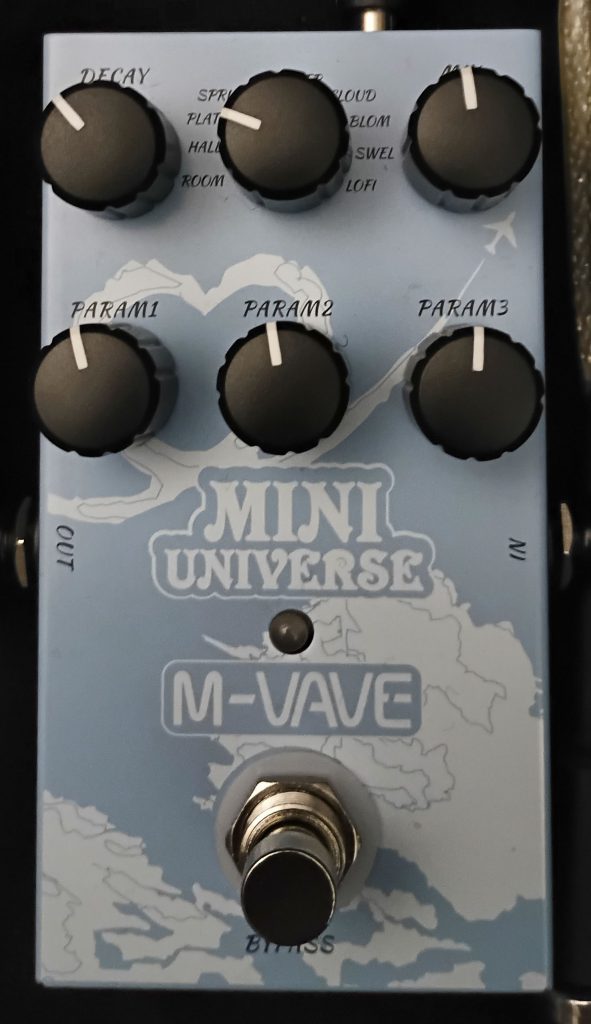
Main Features
- 9 Reverb Types / Variations (Room, Hall, Plate, Spring, Shimmer, Cloud, Bloom, Swell, and Lofi).
- Controls; Type (Variation), Decay, Mix, and Param 1-3.
- True bypass footswitch.
- Mono input and output connectors.
- Power options are standard 9V negative center adapter, and USB-C.
Adjustment Details
As you can see in the picture, the pedal has six knobs and a push foot switch. Knobs are;
- Decay – Adjusts the duration of the “echo”.
- Mix – Adjusts dry/wet levels.
- Param 1-3 – Type dependent controls, see details below.
Testing
I own more than 40 synthesizers, and here I tested this effect unit with my Korg EX-800 synthesizer module. Note that I bought two of these effect pedals, to slightly detune for a nice stereo effect! I did not however, add any external effects or processing. For simplicity’s sake and to prevent the review video from being too long, I kept the various test sounds on the Korg EX-800 synthesizer to a minimum.
Effect type details
On the types below where Param1 and Param2 controls tone frequency, I was happy to discover that the adjustment did not affect the dry signal.
- Room – Simulates a relatively small, simple-structured room, where many reflections are absorbed by soft material, and the sound reflected by the walls
- Param1 – High pass tone control
- Param2 – Low pass tone control
- Param3 – Drift; Pitch of the wet signal, is slightly modulated to produce a “vintage and charming background sound”
- Hall – Gives a wide, slightly scattering feeling, simulating a grand ambient sound.
- Param1 – High pass tone control
- Param2 – Low pass tone control
- Param3 – Drift; Pitch of the wet signal, is slightly modulated to produce a “vintage and charming background sound”
- Plate – Simulates a reverb created in a large metal container, with a very bright and powerful sound.
- Param1 – High pass tone control
- Param2 – Low pass tone control
- Param3 – Drift; Pitch of the wet signal, is slightly modulated to produce a “vintage and charming background sound”
- Spring – Simulates a reverb going through a spring enclosure, which picks up resonance.
- Param1 – High pass tone control
- Param2 – Low pass tone control
- Param3 – Dwell; Controls number of springs.
- Shimmer – An adjustable pitch shifted copy is added to the wet sound, creating dissonant, “scary”, or harmonic and ambience sounds.
- Param1 – High pass tone control
- Param2 – Pitch; Adjusts the pitch shift, where minimum is same as input, and maximum is two octaves above.
- Param3 – Amount; Essentially the level of the pitch shifted sound.
- Cloud – A large ambient reverb.
- Param1 – High pass tone control
- Param2 – Low pass tone control
- Param3 – Diffusion; Softens the early reflections creating a more diffused reverb. As diffusion is increased the reverb is smoothened and softened, so the delay and reverberation mix together more naturally.
- Bloom – More diffusion blocks added to smooth out the sound, with the tendency of the reverb to have a slowly building envelope. Experiment with short decay times and “Length” values, then longer decay times and lower “Length” values to get a feel of the difference and possibilities.
- Param1 – High pass tone control
- Param2 – Low pass tone control
- Param3 – Length; Adjusts the length of the “bloom” portion.
- Swell – Creates evolving textures.
- Param1 – High pass tone control
- Param2 – Low pass tone control
- Param3 – Drift; Pitch of the wet signal, is slightly modulated to produce a “vintage and charming background sound”
- Lofi – Wet signal is subjected to various low fidelity processing, creating a “mystical profound sound, a charming sense of nostalgia suitable for vintage music”.
- Param1 – Adjusts the sample rate
- Param2 – White Noise; Adjusts noise level
- Param3 – Drift;
Connectors
- Power: You have two options which to power this effect pedal.
- Standard negative center pole 9V female socket, minimum 300mA.
- USB-C female socket.
- Input: One ¼” (6.5mm) unbalanced female mono TS jack socket
- Output: One ¼” (6.5mm) unbalanced female mono TS socket
Build Quality: Case, Knobs, and Switches
The metal case is very sturdy. The knobs are ok, although slightly wobbly, and could use perhaps a bit more distance between them, for easier adjustment. The Type (variation) switch however is difficult to switch to a position where it locks, in other words the lock positions are too loose! The foot switch seems very solid and of good quality. The pedal has four small rubber grip feet in each bottom corner, preventing it from sliding much, if any.
Accessories
- None
Documentation
- One tiny booklet, in seven languages, with seven pages per language.
- Provides decent enough information, although the tiny text size is hard to read.
Size
- Dimensions: 60mm wide x 112mm deep x 24mm tall or 40mm tall with the knobs and foot switch.
- Weight: 236 grams
Pros:
- Very affordable.
- Good quality and very useful reverb effects!
- Plenty of adjustment possibilities.
- True bypass switch.
- Solid metal case.
- Decent knobs.
- No audible noise that I was able to notice.
Cons:
- Type selector knob’s lock positions very poor!
- Microscopic manual!
Conclusion
9 reverb types, or variations effects, that are all quite useful, and with a good set of adjustment possibilities. Note off course here usability varies dependent on what music type of instrument you are using it with. In particular you may find a few more useful effect types than me as a keyboardist, if you’re going to use this on an electric guitar. Sound quality is noise-free. Build quality and knob size is decent, although knob spacing could be slightly better. Anyways for under $30 including shipping and tariff taxes, I found it a very deal, so good I bought two!