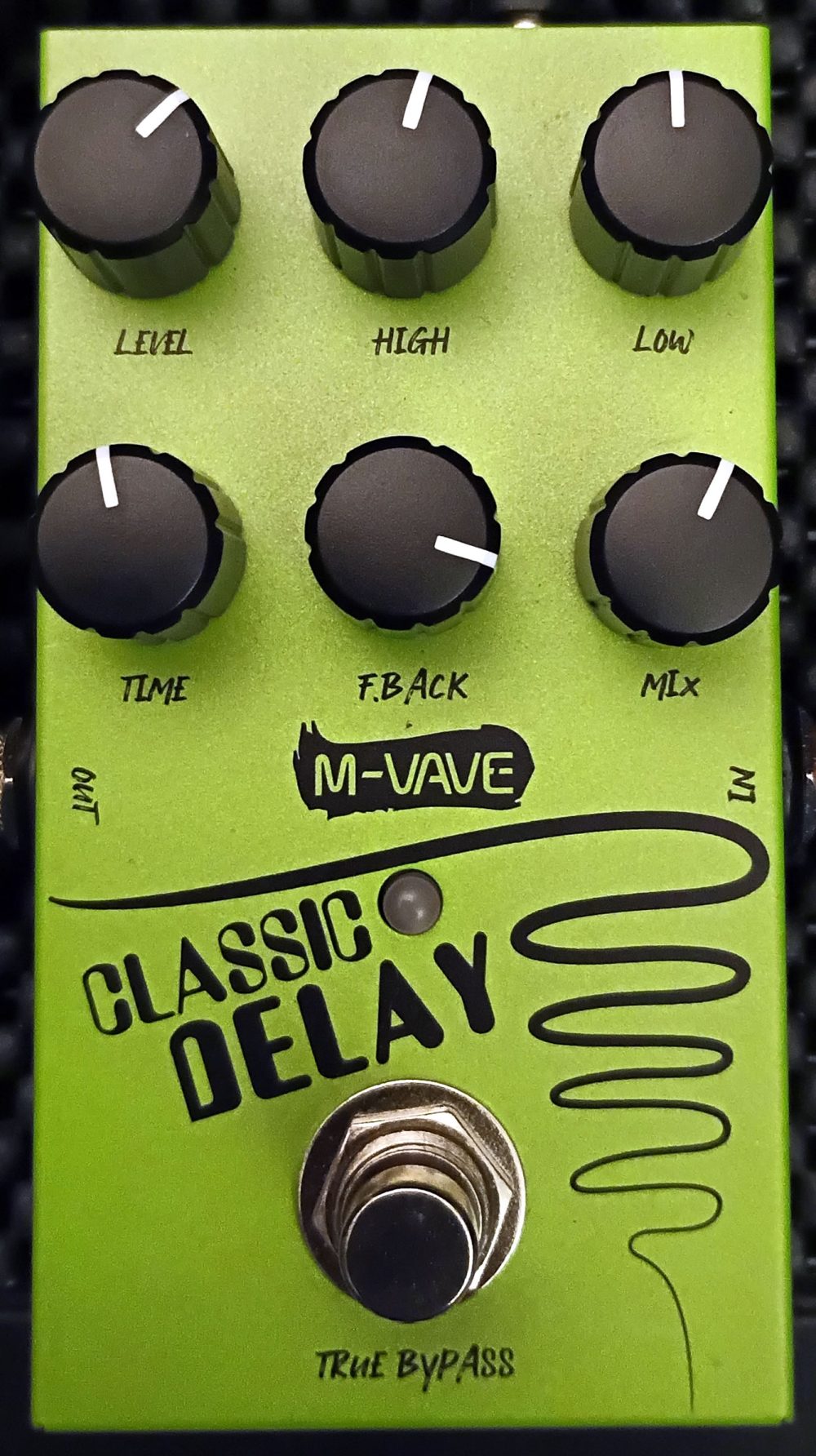
Overview
The M-Vave Classic Delay is a mono delay effect pedal, very economical and off course Chinese made. It is equally useful on guitars and keyboards, including synthesizers. Please note however, that I tested this guitar effect pedal on a keyboard. If you try this out with an electric guitar, your sound impressions and usability will most likely be different from mine. I got one from Amazon several months ago, and another one for only $3.95 shipping during a Black Friday promotion. Now I can slightly detune the two of them for a nice stereo effect.

Main Features
- Pure analog circuit.
- Level, High, Low, Time, Feedback, and Mix adjustment knobs.
- Mono input and stereo output.
- True bypass footswitch.
- Powered by either a standard 9V adapter or a 5V USB-C charger.
Knob Adjustment Details
As you can see in the picture, the pedal has six knobs and one push foot switches. Knobs are;
- Level – Gain adjustment knob, that can be used to match the signal with effect off or on.
- High – Adjusts “high” frequencies, unfortunately also changes the dry signal.
- Low – Adjusts “low” frequencies, unfortunately also changes the dry signal.
- Time – Adjusts the time top first, and in between echoes.
- Feedback – Adjust feedback, or decay time of echoes. Unfortunately, unable to set as high as most other delay.
Testing
Note even though I own more than 40 synthesizers, I tested this with a simple Yamaha PSR-36 keyboard that does not have any internal effect processing. Furthermore, I did not add any external effects or processing. For simplicity and to prevent the review video from being too long, I only tested the following sounds; Brass, Electric Piano, Strings, and Bells.
Check out my YouTube video for sound tests, and in the mean time here are some observations;
- The pedal’s feedback adjustment range is inadequate. Maxes out at about 4 seconds at a low frequency of about 60Hz.
- Maximum time of delayed signal is better at lower frequencies, with time decreasing with increased frequency, to a point around 3KHz where there are no more perceivable echoes.
- Parallel to the above noted decrease in echoes being present at higher frequencies, harmonic and noise distortion is introduced into the wet signal.
- By carefully adjusting the “Time” knob to lowest or very low settings, and tweaking the “Feedback” knob, you can obtain various effects other than delay.
- Simple Non-Modulated Flanging – Adjust delay time 0.1ms to 10ms, turning knob all the way to minimum or close to, and Feedback knob to maximum.
- Simple Non-Modulated Chorus – Adjust delay time to 5ms to 50ms, keeping knob around 9 o’clock position, and feedback all the way down or very low.
- Simple Small Room Reverb – Adjust delay time very low, and feedback around middle position.
Except for the inadequate feedback adjustment range, which I would like to be higher as in longer echoes, I fully realize the increased distortion and fewer echoes at higher frequencies is how an analog bucket brigade delay functions. So, in that respect this effect unit is most likely a BBD delay circuit.
Connectors
- Power: There are two options to power this effect pedal. One with a standard negative center pole 9V female socket, and the other with a USB-C plug connected to a charger. Power requirements are 300mA.
- Input: One ¼” (6.5mm) unbalanced female mono TS jack socket
- Output: One ¼” (6.5mm) unbalanced female mono TS socket
Build Quality: Case, Knobs, and Switches
The metal case and knobs are solid and sturdy. Spacing between knobs in each row, although I’d prefer better, is quite workable. The foot switch seems of solid and good quality. The pedal has four small large rubber grips glued to underside of each corner, preventing it from sliding much, if any.
Accessories
- None
Documentation
- Included in the box is one tiny 2.5” x 3.5” “User Manual” in multiple language, each covering five pages.
- Provides decent enough information, but will strain your eyes. Twice the size would have been nice!
Size
- Dimensions: 68mm wide x 112mm deep x 40mm tall
- Weight: 221 grams
Pros:
- Very affordable!
- Analog bucket brigade (BBD) processing with associated muddy and gritty sound.
- Good sets of adjustment possibilities.
- True bypass.
- Sturdy knobs.
Cons:
- Inadequate maximum feedback control provides only echoes up to about four seconds, at about 60Hz input frequency.
- High and low tone controls also affect the dry signal.
- Tiny manual!

Conclusion
For about $30 you get an analog delay and that would have been somewhat of a bargain, had it not been due to a few design flaws, that being inadequate feedback control plus tone controls that also effects the dry signal. Still, I find a use for it in my studio, where I either use one to create a stereo signal from a mono source. I do that by splitting my instrument signal, and route one directly to my preamp / mixer, and the second first to one of the delay’s using it to slightly delay the signal, and adjusting to wet only. I also use two together and slightly detune “Time” for a stereo delay effect.
6 thoughts on “Review: M-Vave Classic Delay Effect Pedal”
This is not bbd device. It is pt 2399 delay, but chip is tamed, completely. Short delay time, less repeats – it means less noise, too.
Hello! Does it go fully wet?
Yes
Thank you. But to be sure, as that is important to me and rare in a cheap non-DSP delay:
With the Mix knob all the way clockwise, THERE IS NO DRY SIGNAL, right?
No, it doesn’t go fully wet.
I’ve found a demo with the Mix knob all the way clockwise: there is still a dry signal.
https://youtu.be/x2bIaVsk0O8?si=o7zi_IhkG99Z7rSJ&t=168
Which is, again, expected for these cheap PT2399-based pedals.
My bad, you’re right. I just re-tested and can confirm it does not go fully wet.