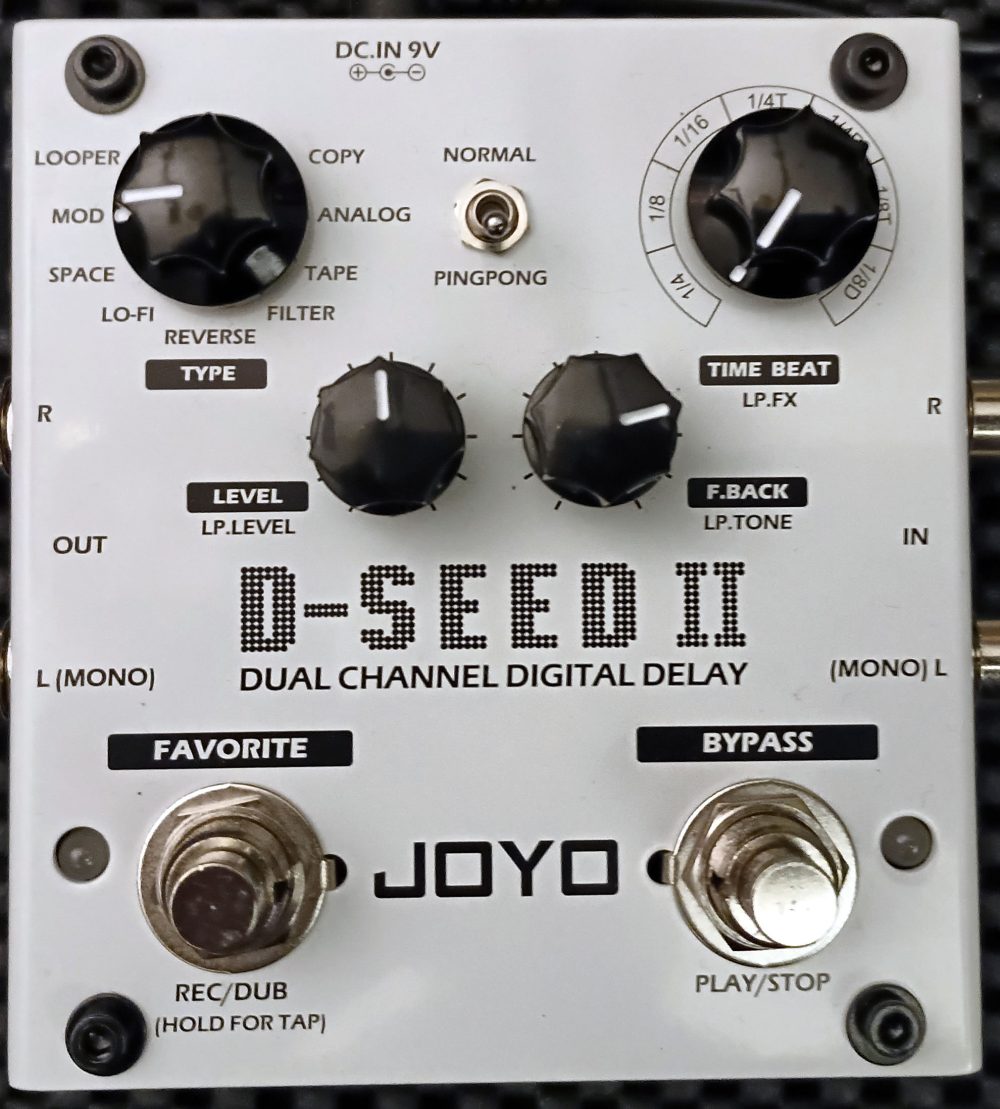
Overview
The Joyo D-SEED II Dual Channel Digital Delay is an economical Chinese made, multi-variation delay effect and looper pedal, equally useful on guitars and keyboards, including synthesizers. Please note however, that I tested this guitar effect pedal on a keyboard. If you try this out with an electric guitar, your sound impressions and usability will most likely be different from mine.

Main Features
- 8 Delay Variations (Copy, Analog, Tape, Filter, Reverse, Lo-Fi, Space, and Mod).
- Maximum of two seconds delay time.
- Stereo ping-pong, can be toggled on or off, for each delay variation. Produces a stereo signal from a mono signal.
- Looper function with a maximum of 3 ½ minutes of recording time.
- Stereo input and output connectors.
- Standard “Time”, here named “Time Beat”, “Feedback”, as well as “Level” (dry/wet) control knobs.
- Left footswitch has the following functions
- Delay Mode
- Tap tempo
- Loading and saving of a patch of knob parameters (Individual for each channel)
- Looper Mode
- Recording and dub function.
- Delay Mode
- Right footswitch has the following functions
- Delay Mode
- Bypass on or off
- Looper Mode
- Play and stop of recorded sound
- Delay Mode
Adjustment Details
As you can see in the picture, the pedal has four knobs and two push foot switches. Knobs are;
- Type – Use this to select the delay variation or looper function, see detailed description below.
- Time Beat / LP.FX
- Delay Mode – Adjusts time until the first delay is audible, up to 2 seconds. Note you can also adjust the delay time by using the “TAP” footswitch.
- Looper Mode – Adjusts “depth of playback”.
- Level / LP. Level
- Delay Mode – Adjust dry/wet mix ratio
- Looper Mode – Adjust playback level
- F.Back / LP.Tone
- Delay Mode – Adjusts how long the echo effect will go on, all the way up to more than two minutes!
- Loop Mode – Tone adjustment
Testing
I own more than 40 synthesizers, and here I tested this effect unit with my Waldorf Rocket and Waldorf Streichfett synthesizer modules, both without any internal effect processing. Furthermore, I did not add any external effects or processing, except adding a minimal (10ms) delay with no feedback, using another pedal and only on one channel, to demonstrate difference between mono-stereo versus true stereo ping-pong effect. For simplicity’s sake and to prevent the review video from being too long, I kept the various test sounds on each synthesizer to a minimum.
Effect type details
- COPY – Clean digital delay effect.
- ANALOG – This delay effect is apparently designed to emulate one made with analog components. It does this by cutting high frequencies and slightly deteriorate signal over time, giving it the classic bucket brigade delay (BBD) sound. I like this delay type a lot!
- TAPE – This delay effect emulates a tape delay which uses magnetic tape to create echoes, known for its warm, saturated, and slightly warbled sound due to physical imperfections.
- Filter – Adds a periodical varied modulated filter into the signal, changing with the delay time. To me, and at least for some sounds, it sounds almost indistinguishable from the “TAPE” variation.
- REVERSE – Reverses the delayed signal, creating a “psychedelic” effect.
- LO-FI – Adds a de-sampling filter to the delay effect, imitating the early electric music’s lo-fi crude tone.
- Space – As in the “COPY” variation, buts adds a reverb effect after the delay, obtaining a spatial tone.
- MOD – Modulated delay sound, characterized with a wide and spatial tone.
Connectors
- Power: There’s just one option to power this effect pedal, and that is with a standard negative center pole 9V female socket, minimum 220mA.
- Input: 2 x ¼” (6.5mm) unbalanced female mono TS jack sockets
- Output: 2 x ¼” (6.5mm) unbalanced female mono TS sockets
Build Quality: Case, Knobs, and Switches
The metal case is very sturdy. The knobs are nice size and very sturdy, with a good distance between them, so it is easy to turn and adjust. Foot switches seem very solid and of good quality. The pedal has four small rubber grip feet in each bottom corner, preventing it from sliding much, if any.
Accessories
- None
Documentation
- One dual sided letter size paper, each containing a single-page manual, one in English.
- Provides decent information, although a bit small. Funny thing though they can’t even get the dimensions of the unit correct!
- A much larger 8-page manual is available from Joyo’s website.
Size
- Dimensions: 95mm wide x 105mm deep x 46mm tall
- Weight: 555 grams with box
Pros:
- Very affordable.
- High quality and very useful delay effects!
- Looper recording, dub, and playback function
- Stereo Input and Output.
- Mono to Stereo Processing – From either a single mono input, or two identical mono inputs! Even produces a stereo signal when dry level is set to 100%!
- FB (feedback) adjustment – Able to set feedback to more or less “infinity”!
- Preset storage – Individual for each input?!?
- True bypass switch.
- Delay time adjustable via tap foot switches.
- Solid metal case.
- Sturdy knobs.
- No audible noise that I was able to notice.
Cons:
- Nothing really to complain about!
Conclusion
8 Delay variations effects that are all quite useful. Stereo signal from a mono source. Note off course here usability varies dependent on what music type of instrument you are using it with. In particular you may find a few more useful effect types than me as a keyboardist, if you’re going to use this on an electric guitar. Sound quality is noise-free. The addition of a looper function, and ability to save parameters as preset is a nice bonus. Build quality including knobs is solid, and knob size and spacing is also good. At about $90 including shipping and tariff taxes, I found it a pretty good deal. Yes, it’s a keeper!
Improvement Suggestions
For this effect pedal to be “perfect”, well for my usage, I have the following suggestions to Joyo.
- A tone control for the wet signal only would be nice.
- A modulation section with Rate, Depth, and Level would be very nice!
One thought on “Review: Joyo D-SEED II Delay / Looper Effect Pedal”
thanks for info.